
The new diio: from visibility to action
By
Paolo de diio
|
10
minutes
There is a very important part of an organization’s work that does not happen in dashboards, reports, or the CRM.
It happens before: in a meeting with a client, in a difficult call, in a negotiation that changes tone, in an objection that appears between the lines, or in a commitment someone makes but no one records.
For years, many companies treated those conversations as something temporary: something that happens, gets summarized, stored, and then left behind. But the truth is that a large part of an organization moves there. That is where real problems are understood, opportunities open and close, risks appear before they become losses, and signals are revealed that often reach formal systems too late.
When we started building diio, we began with a simple belief: conversations are one of the most valuable assets any team has, but also one of the least leveraged.
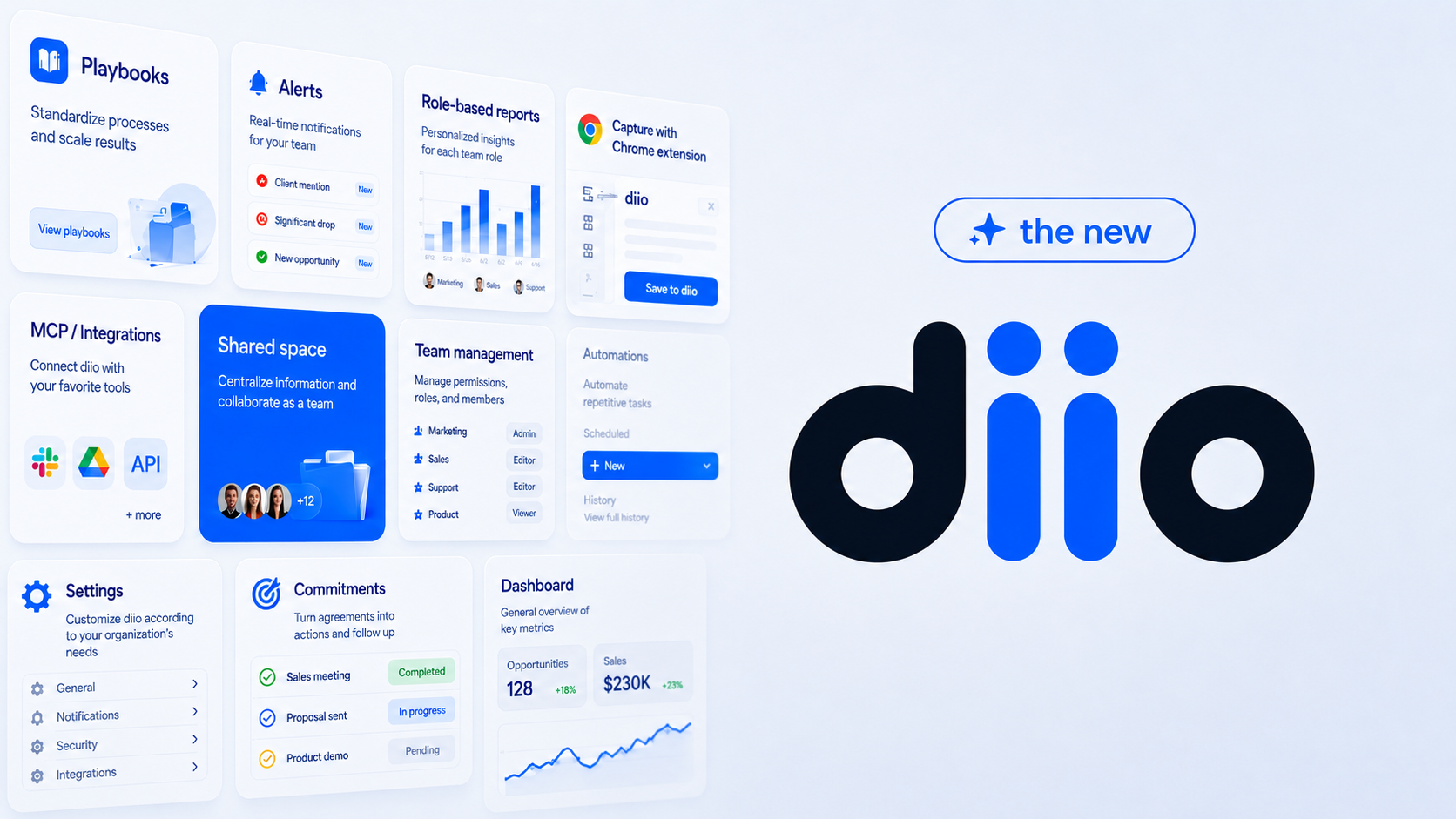
Today, we are introducing the new diio.
And for us, this is not just a new version of the product. It is probably the most important step we have taken since we started.
For a long time, technology was able to do something very useful with conversations: record them, transcribe them, summarize them, and organize them. That solved part of the problem. But it was not enough.
Knowing what happened helps. Understanding what it means helps much more. And acting on time can completely change the outcome.
The new diio was born from that idea: helping teams not only look at their conversations, but turn them into signals, decisions, and next steps.
Until now, diio gave you visibility.
Starting today, diio begins to give you direction.
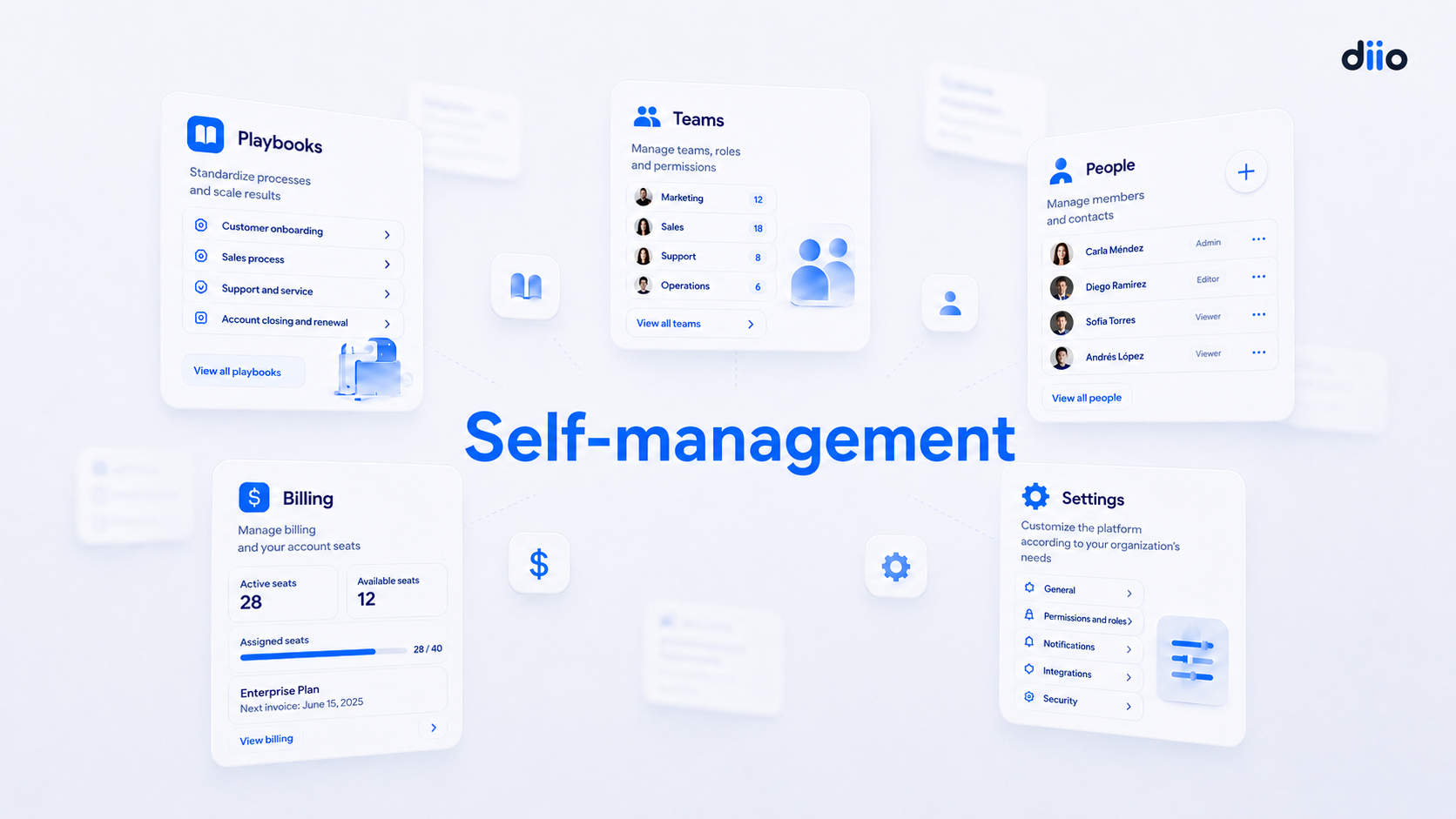
New administrators to operate with more autonomy
The new diio also introduces a clearer and more flexible way to manage the platform.
From now on, companies can define new administrators to better manage their operation inside diio. This makes it possible to distribute responsibilities, organize teams, manage permissions, and avoid having every adjustment depend on a single person or on our team.
This change is especially important for companies with several teams, different business units, or multiple use cases inside diio.
A sales team may need certain playbooks, permissions, and views. Customer success may operate with different criteria. A recruiting, procurement, or investment team may require a completely different configuration.
With the new administrators, each organization can adapt diio to its real structure: who participates, who can configure, who can access certain information, and how teams are organized inside the platform.
The idea is simple: to let every company operate diio with more autonomy, more order, and more control.
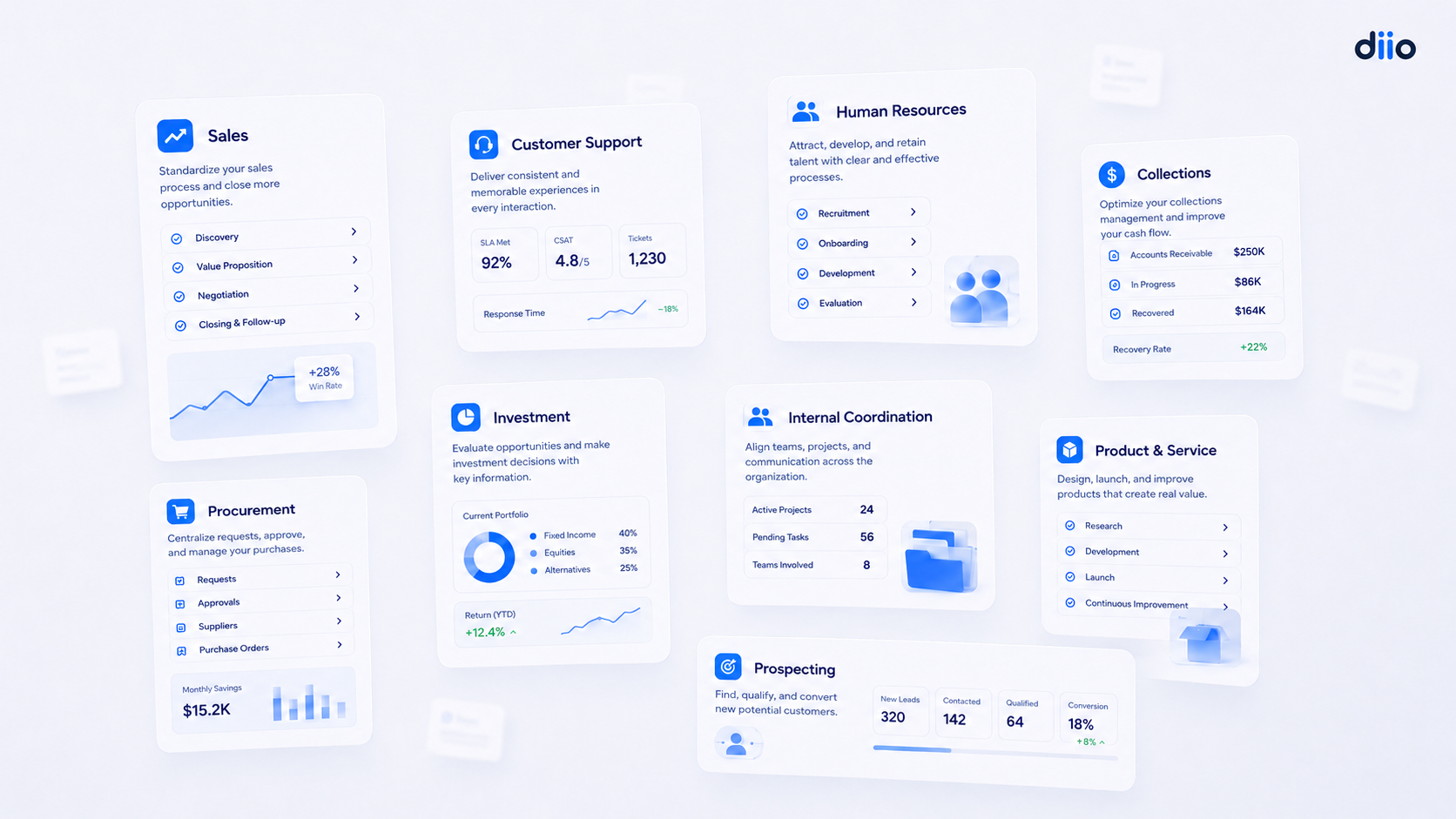
Configurable playbooks for many more use cases
Playbooks have always been a central part of diio. But in this new version, they become much more important, because they now make it possible to bring diio’s intelligence to many more types of conversations, not just sales.
This opens up a huge possibility: using diio in any conversation where there is a goal, a decision, a signal, a negotiation, or a commitment.
In sales, a playbook can help understand whether an opportunity is truly moving forward. In customer success, it can detect early signs of dissatisfaction or churn risk. In procurement, it can record conditions negotiated with suppliers. In recruiting, it can identify a candidate’s expectations, motivations, and risks. In investment, it can organize questions, objections, and next steps. In internal teams, it can turn coordination meetings into clear agreements.
That is one of the biggest changes in the new diio: each company can build playbooks for the conversations that truly matter in its operation.
A playbook is the way a company tells AI what to look for in a conversation, what questions it should answer, what signals it should detect, and what information it should structure. It is what makes it possible to transform open, different, and often messy conversations into a shared source of learning, follow-up, and action.
Until now, many configurations depended on our team: creating or adjusting playbooks, adapting fields, organizing teams, changing permissions, or preparing new analysis flows. That worked, but it was not enough for companies that move fast.
From now on, each company can configure its operation directly in diio: define new administrators, create teams, assign participants, manage permissions, and build playbooks in just a few minutes.
For example, if you want diio to detect a client’s budget, identify their current provider, record a key objection, and copy that information to the CRM, you can now configure it yourself.
No custom development. No tickets. No waiting for an implementation.
This change matters because many organizations already have valuable conversations across different areas, but they do not always have a consistent way to learn from them. Each executive takes notes differently. Each leader reviews partial information. Each team interprets signals using its own criteria.
Playbooks help organize that intelligence. Not to remove people’s judgment, but to give them better context. So different conversations can be analyzed with common criteria. So leaders can detect patterns. So teams can improve with more clarity. So companies can learn from what is already happening every day.
The new diio does not impose a single way of working. It gives each organization the ability to build its own, use case by use case, team by team, conversation by conversation.
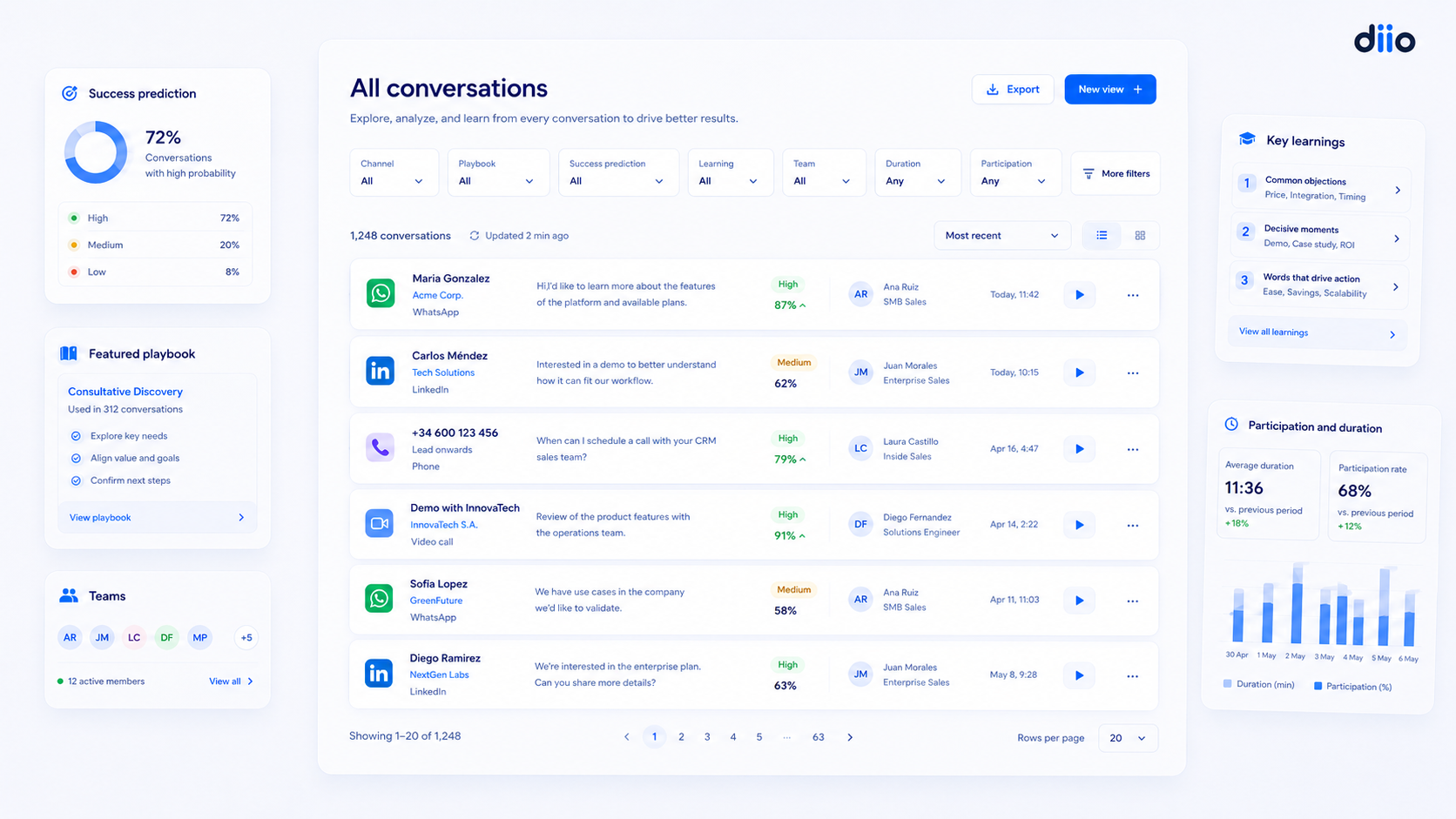
All conversations, in one place
The new diio also changes the way information is navigated.
Before, conversations were more separated by origin: meetings, calls, team activity, or personal activity. That was useful, but also limited. Because in practice, what matters is not always where a conversation happened. What matters is what it means.
A call can reveal churn risk. A meeting can show strong interest. A message can contain a key objection. An internal conversation can unblock an opportunity.
That is why the new All Conversations view brings analyzed meetings, calls, and messages together in one place.
From there, you can search by client, topic, or keyword; filter by channel, date, playbook, prediction, performance, stage, executive, or team; and find conversations where a competitor, an expansion signal, low morale, high interest, or urgent follow-up appeared.
The result is a deep change: conversations stop being a chronological list and start becoming a source of signals.
It is no longer just about reviewing what happened. It is about finding what deserves attention.
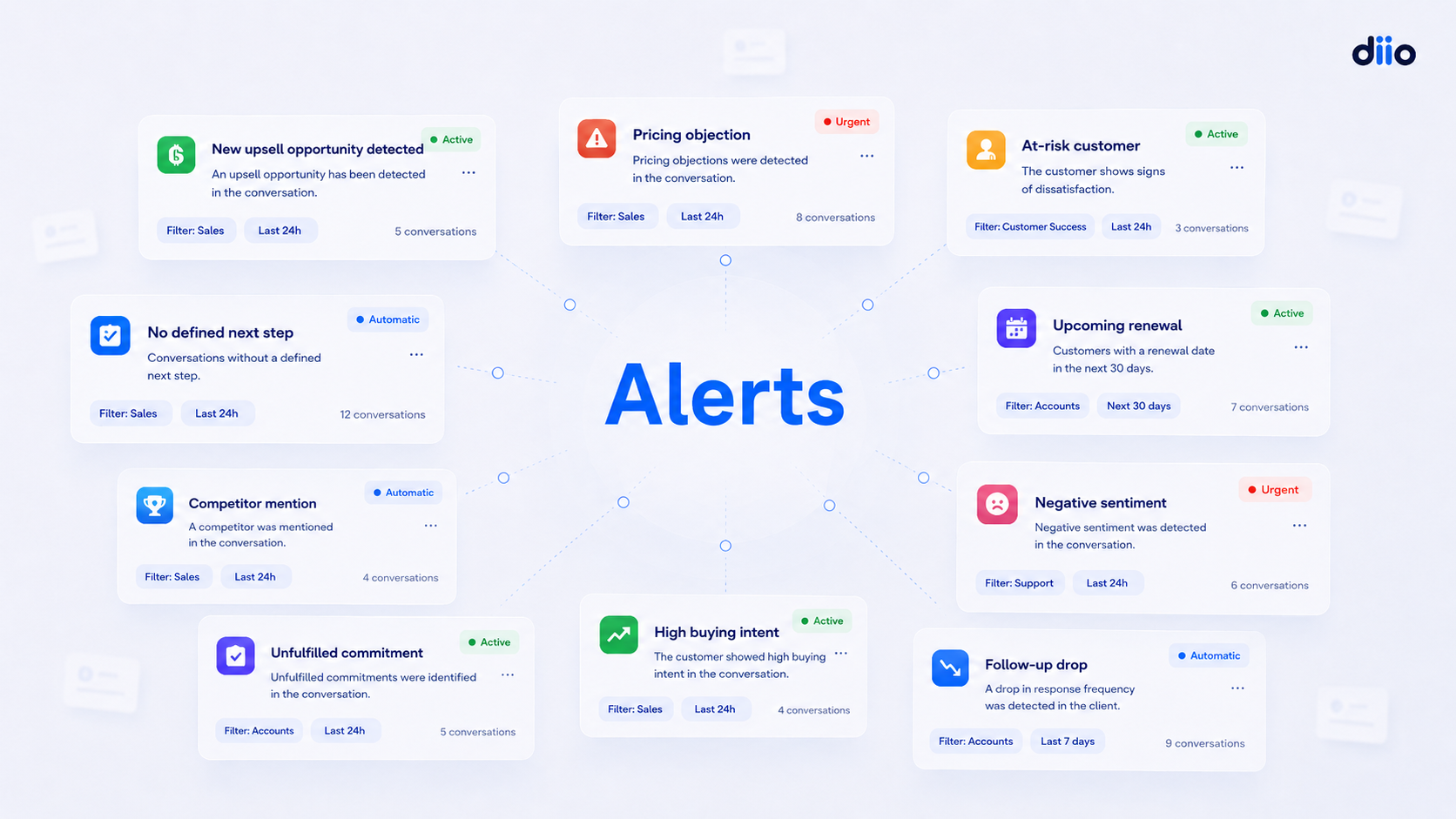
Dynamic views and alerts to act earlier
Not every team needs to look at the same things.
A sales leader may want to see large opportunities with a low success prediction. A customer success team may want to detect clients showing signs of churn. A manager may want to review conversations where a competitor was mentioned. An executive may want to follow meetings where commitments were left without a date. An operations team may want to monitor conversations with delays or risks.
With the new dynamic views, each user can create filters based on what they need to observe and save them as views. This changes the way teams operate, because a view is no longer just a temporary filter: it can become a permanent way of looking at the business.
And when a new conversation meets those conditions, diio can notify you by email or Slack.
That means you no longer have to log in every day to search for whether something important happened. diio can notify you when a signal that deserves attention appears: a conversation with risk, an opportunity with high intent, a client who showed interest again, a repeated objection, a critical commitment, or a pattern that could previously be missed.
That is the heart of the new diio: helping teams decide earlier.
Before the client goes cold. Before an opportunity stalls. Before a signal gets lost. Before a decision comes too late.
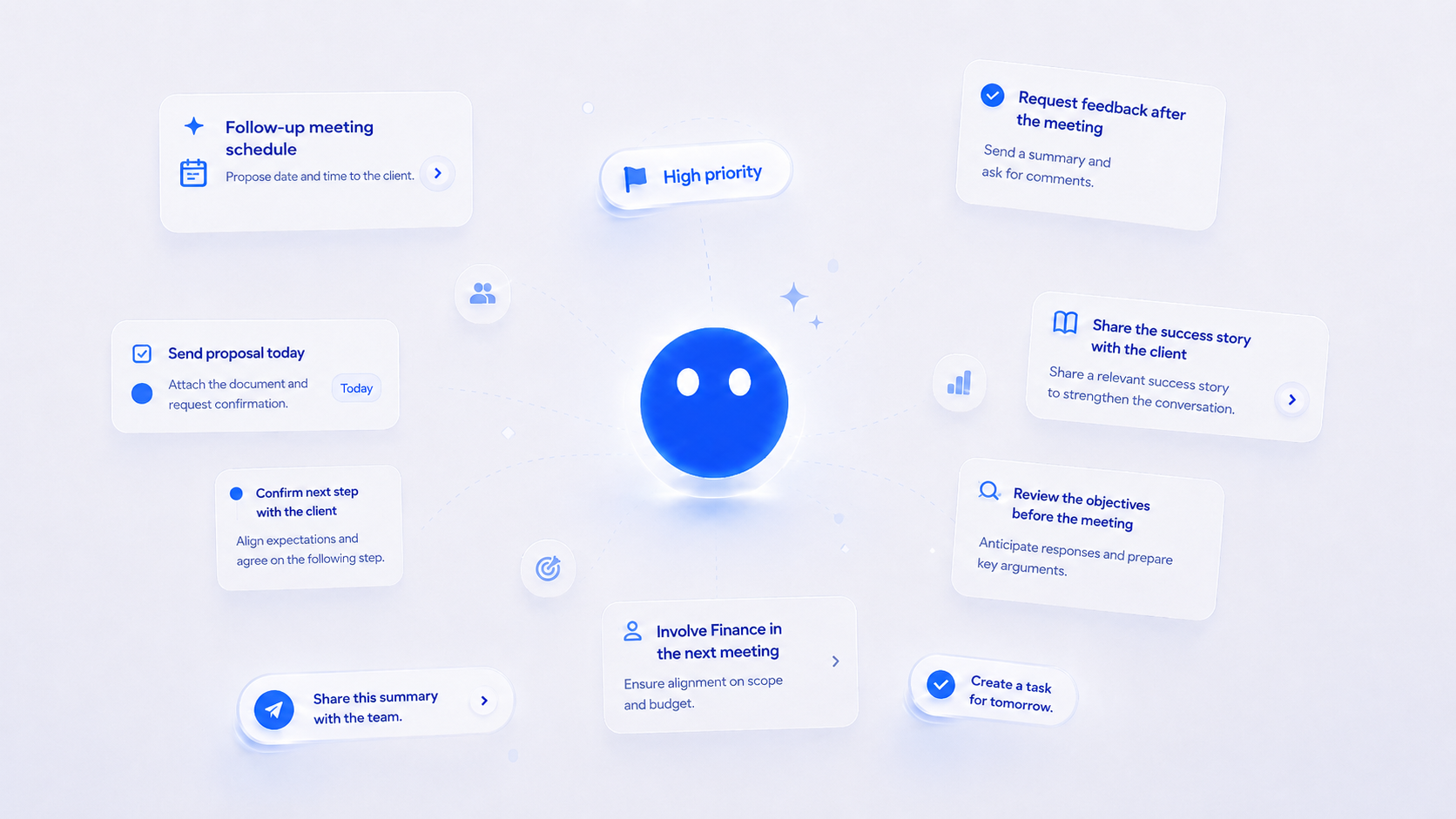
Suggested next actions
Another important change is what happens after each conversation.
Until now, many tools could generate summaries or commitments. That is useful. But many times, the most important thing in a conversation was not said as an explicit task.
Sometimes no one says “we should involve another person,” but the conversation makes it clear. Sometimes no one says “this objection was not resolved,” but you can tell. Sometimes no one says “this client needs more concrete evidence,” but the signal appears.
The new diio begins to detect those opportunities and suggest next steps. It can recommend going deeper into an objection, bringing in a stakeholder, sending a success story, clarifying a weak point, strengthening a proposal, unblocking a decision, or following up on a topic that was left open.
This is different from simply recording commitments.
A commitment is something someone said they would do. A suggested next action is an intelligent reading of what should be done.
And that difference matters. Because many times, the outcome of a conversation depends on what happens afterward: the speed of follow-up, the quality of the email that comes next, the ability to detect a signal in time, and the clarity with which the team understands what is really at stake.
The new diio helps close that gap.
It does not replace human judgment. It supports it.
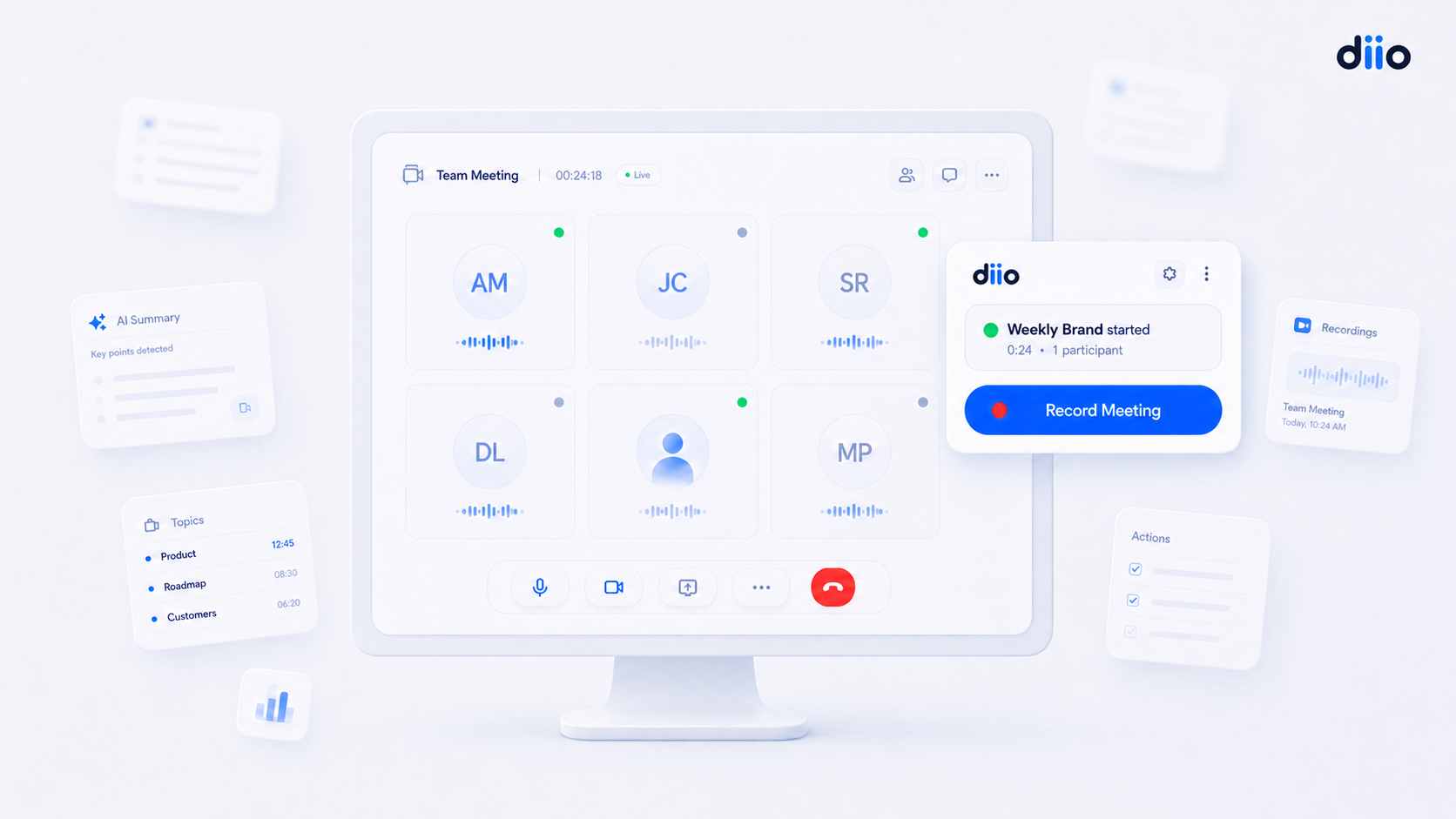
More ways to capture conversations
For diio to be useful, it needs to be where conversations happen. And conversations do not happen in just one place.
That is why the new diio also improves the ways meetings, calls, and messages are captured.
From now on, you can record meetings in Meet or Teams without diio appearing as a guest in the room. This allows the conversation to remain more natural, while diio continues doing its job: recording, processing, and helping you understand what matters.
To use this option, you need to install the Chrome extension and have a company administrator enable it.
We have also advanced in message analysis, because many relevant conversations do not happen in a formal meeting, but in channels like WhatsApp or LinkedIn.
And we added a new way to use diio through WhatsApp. By setting up your phone number in your preferences, you can interact with diio from WhatsApp, ask questions about your conversations, and upload audio from calls or in-person meetings so they can be analyzed.
This is especially important for teams that work in the field, make calls outside the CRM, have in-person meetings, or need a quick way to bring context into diio without changing how they work.
The idea is simple: for diio to better adapt to each team’s real workflow.
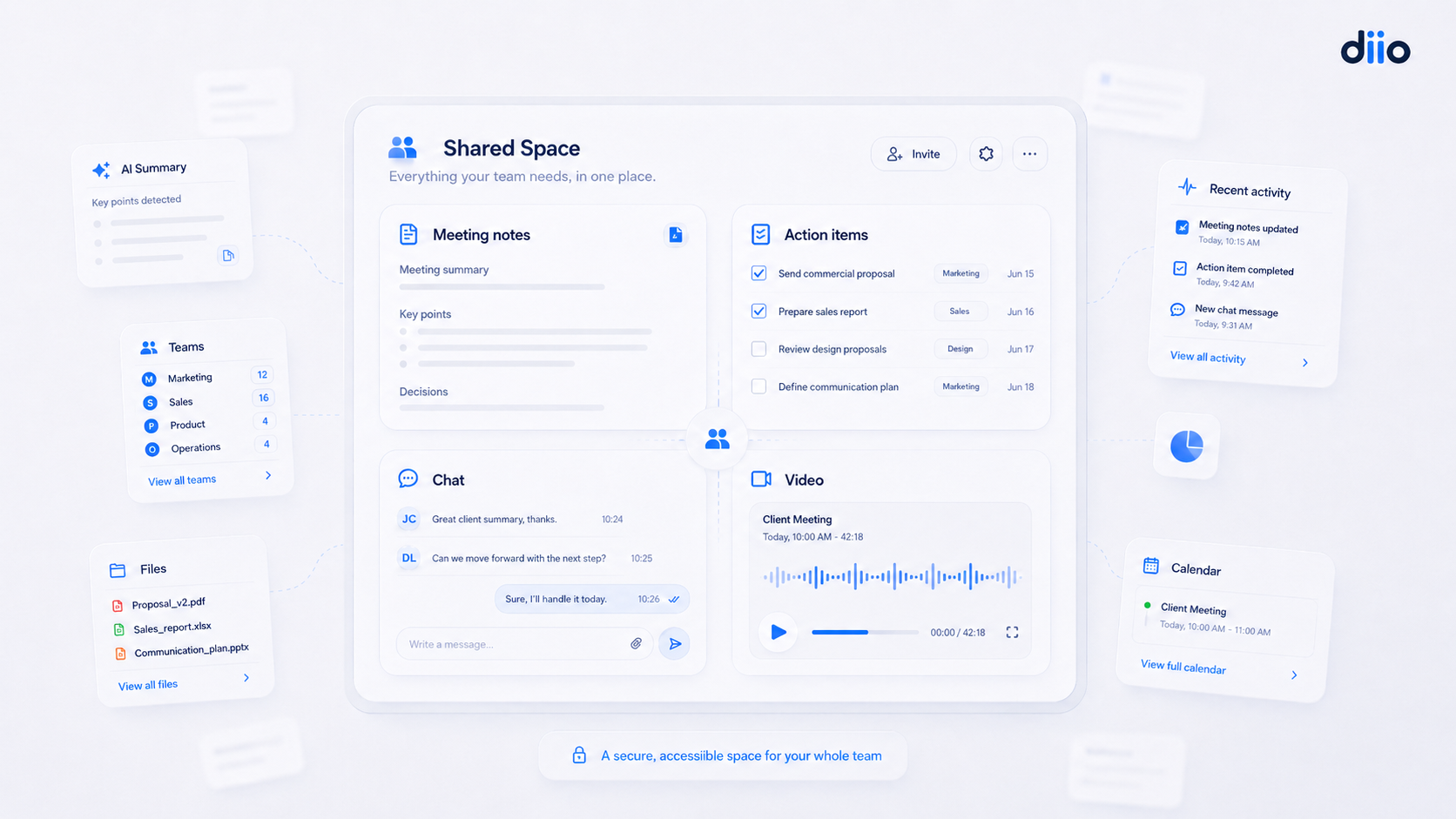
Shared Space: the conversation continues after the meeting
An important conversation does not end when the call ends.
After that comes follow-up, internal review, the client’s questions, commitments, documents, and the decision that has not yet been made.
That is why the new diio introduces Shared Space: a place where the client or counterpart can review the meeting notes, see commitments, ask questions, and revisit what was discussed.
This changes the post-meeting experience. Context does not get buried in an email, commitments do not depend only on memory, and the conversation can continue moving forward in a clear space.
In addition, the team can know when the client reviews that space, what activity they had, and what signs of interest appear after the meeting.
This opens up a new way to understand follow-up. Not just as “I sent an email,” but as “I know whether the client looked again, whether they interacted, whether they moved forward.”
The conversation stays alive. And that makes it possible to support it better.
We also improved what you already use every day
This release also includes important improvements in areas many teams already use every day: reports, in-person meetings, security, and operations.
We are introducing audiio, our own speech-to-text model, trained especially on the Spanish spoken in Latin America. Because transcribing well is not just turning voice into text: it means understanding accents, rhythms, proper names, local expressions, business contexts, and real ways of speaking.
We have also advanced in new security, compliance, and operational implementations and standards, aligned with relevant regulations in the region, such as LGPD in Brazil, Law 21.719 in Chile, LFPDPPP in Mexico, and Law 1581 in Colombia.
Because if diio is going to become an intelligent layer over important conversations, it has to do so with the seriousness those conversations require.
Why this launch matters
This release is not just a sum of features. It is not just a new interface, more configuration, more channels, or better reports.
It is a new stage.
The new diio is built so conversations do not remain isolated, scattered, or buried. It is built so every team can better see what is happening, detect what matters earlier, and act with more clarity.
A conversation can be just another meeting. Or it can be an early risk signal, an expansion opportunity, a critical objection, a pending commitment, a decision that needs to move forward, or a learning for the whole team.
The difference lies in whether someone manages to see it in time.
That is what we want diio to do better every time: help teams understand not only what was said, but what it means; not only what happened, but what is at stake; not only what needs to be remembered, but what should be done next.
The new diio is more flexible, more powerful, more configurable, and more connected to each team’s real operation.
But above all, it is designed to help teams decide earlier.
And this is just the beginning.
We will keep improving diio every day, listening to our clients, learning from their conversations, and building a platform that helps transform every important interaction into clarity, focus, and action.
Thank you for using diio.
And thank you for building this new stage with us.
.png)

Let them sell
diio analyzes your conversations and helps you prioritize, move quickly and make better decisions.
Try it for free
.avif)